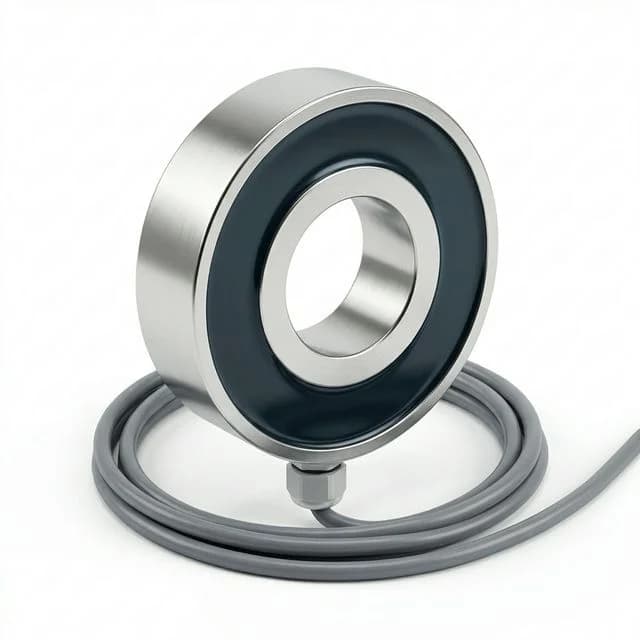
Solenoid Actuators vs. Pneumatic Cylinders: 2026 TCO and Energy Efficiency Guide
Compare solenoid actuators vs pneumatic cylinders for 2026 TCO, compressed-air leaks, energy use, break-even logic, and RFQ audit steps.
One-Line Decision: If your facility is under 2026 energy-cost, Scope 2, or mobile-robot power-budget pressure, replacing the right pneumatic cylinders with electromagnetic solenoids can materially reduce energy OpEx, despite a higher upfront unit cost.
Are you evaluating the switch from pneumatics to electromechanical actuation? Contact our engineering team to audit your current holding force requirements and specify high-efficiency custom electromagnets, linear solenoid actuators, or continuous-duty solenoids.
Published / updated: 2026-07-25. Scope: Global buyer-side specification, engineering comparison, and procurement strategy for transitioning from compressed-air actuation to electromechanical solenoids. Focuses on Total Cost of Ownership (TCO), energy efficiency, and RFQ screening; it is not regional legal advice or a substitute for measured plant-air audits.
Quick Navigation
- Executive Summary: The 2026 Shift from Air to Electric
- The Physics of Efficiency: 10-30% vs 70-80%
- Deconstructing Total Cost of Ownership (TCO)
- Architecture Comparison (Data Table)
- Visualizing the TCO Break-Even Point (SVG)
- Engineering Boundaries: When NOT to Replace Pneumatics
- The Procurement Audit: TCO Evaluation Checklist
- FAQ for Procurement & Engineering
- Sources and References
Executive Summary: The 2026 Shift from Air to Electric
For decades, compressed air has been the undisputed muscle of industrial automation. Pneumatic cylinders are cheap to buy, incredibly rugged, and easy to replace. However, as energy costs remain volatile and manufacturing facilities track Scope 2 electricity use more closely in 2026, the hidden costs of pneumatics are under heavy scrutiny.
Compressed air is inherently inefficient. Producing it, drying it, transporting it, and regulating it wastes energy before any physical work is even done. Procurement teams are increasingly looking toward electromechanical actuators (solenoids and linear motors) where the duty cycle, force profile, and safety zone fit. While solenoids demand a higher initial capital expenditure (CapEx), their direct-drive nature can improve Total Cost of Ownership (TCO) in high-cycle, high-leakage, or mobile applications.
This guide provides a structured framework for buyers and engineers to evaluate when to retain legacy pneumatic systems and when to invest in high-efficiency solenoids.
The Physics of Efficiency: 10-30% vs 70-80%
The core argument against pneumatic cylinders lies in thermodynamic losses.
When a facility uses a pneumatic cylinder, the electrical energy from the grid goes through multiple loss-inducing conversions:
- Compression: The electric motor drives the compressor (losing heat).
- Cooling and Drying: Hot air must be cooled and dried (energy spent).
- Transmission: Air travels through pipes, experiencing friction and pressure drops.
- Leakage: A typical facility loses 20% to 30% of its compressed air to "silent leaks" in fittings and seals.
- Actuation and Exhaust: The cylinder fills with air to move, and when it returns, that pressurized air is vented to the atmosphere—wasting all the stored energy.
The U.S. Department of Energy's compressed-air sourcebook treats typical overall compressed-air efficiency as 10% to 15%. In actuator TCO comparisons, pneumatic systems are commonly modeled at roughly 10% to 30% efficiency once compressor, drying, leakage, distribution, and exhaust losses are included.
By contrast, an electromagnetic solenoid converts electrical energy directly into a magnetic field, and then into linear motion.
- There are no transmission losses (beyond minimal I²R heating in the copper wiring).
- There are no compressed-air leaks when the system is idle.
- With bistable (latching) solenoids, energy is only consumed for the switching pulse. Holding the position is done mechanically or magnetically rather than by continuous coil current.
Published electric actuator comparisons often model electric systems at 70% to 80% efficiency. A solenoid design still needs a duty-cycle and thermal check because continuous holding current can waste energy as heat; the strongest energy case is a pulse-driven or latching design where standby power is near zero.
Deconstructing Total Cost of Ownership (TCO)
Procurement decisions based solely on unit price will usually favor pneumatics. A basic pneumatic cylinder might cost $50, while an equivalent industrial solenoid actuator with integrated control electronics might cost $200. To make an accurate sourcing decision, buyers must map out the 3- to 5-year TCO under their own utility rate, compressor controls, cycle rate, and maintenance assumptions.
1. Initial Capital Expenditure (CapEx)
- Pneumatics: Low unit cost. However, the true CapEx includes the prorated cost of the compressor, air receiver tanks, FRL (Filter, Regulator, Lubricator) units, and extensive piping.
- Solenoids: High unit cost. The infrastructure cost is limited to standard electrical wiring and DC power supplies (often 24V or 48V).
2. Infrastructure and Installation
- Pneumatics: Requires plumbing, leak testing, and regular draining of condensation. Routing stiff air hoses through robotic arms or dynamic assemblies is challenging and prone to crimping.
- Solenoids: Requires basic cable routing. Cables are flexible, immune to pressure drops, and can be easily integrated into standard drag chains. This is highly advantageous in Autonomous Mobile Robots (AMRs) which cannot carry bulky air compressors.
3. Energy Consumption (OpEx)
- Pneumatics: Most of the purchased electricity is lost before useful motion because compression, drying, distribution, leakage, pressure drops, and exhaust all consume energy.
- Solenoids: Power can be drawn on demand. This is the largest cost-recovery lever when the design uses pulse operation, latching force, or short energized duty cycles instead of continuous holding current.
4. Maintenance and Downtime
- Pneumatics: Seals degrade over time, leading to worsening leaks. Moisture in the air lines can cause internal corrosion. Routine maintenance is mandatory.
- Solenoids: The magnetic circuit is solid-state, but the armature, spring, bearing surface, seals, and driver still need qualification. Maintenance is usually lower than pneumatics, but rated cycle life must be verified against stroke, side load, dust, temperature, and duty cycle.
Architecture Comparison (Data Table)
This matrix compares the structural and operational differences between the two technologies to aid in BOM qualification.
| Evaluation Criteria | Pneumatic Cylinders | Electromagnetic Solenoids |
|---|---|---|
| Energy Efficiency (System) | 10% - 15% typical overall compressed-air efficiency; 10% - 30% often used in actuator TCO comparisons | 70% - 80% in published electric actuator comparisons; solenoid result depends on duty cycle and heat |
| Initial Unit Cost | Low | Moderate to High |
| Infrastructure Required | Compressors, Piping, FRL, Valves | DC Power Supply, Wiring, Relays/Drivers |
| Standby Power / Leakage | High if the air network leaks or must stay pressurized | Near zero for bistable/latching designs; continuous-duty coils still draw holding current |
| Maintenance Burden | High (Seal replacement, leak hunting, lubrication) | Very Low (Minimal moving parts, sealed designs) |
| Precision and Control | Limited without servo-pneumatic hardware; standard cylinders are mostly end-to-end motion | Good for fast strokes and proportional force with the right driver; not a servo replacement unless specified that way |
| Environmental Impact | Higher footprint in leaky, high-use systems because wasted compressed air becomes wasted electricity | Lower footprint when duty cycle, driver design, and latching/short-pulse operation reduce purchased energy |
| Hazardous Environments | Ideal (Inherently spark-free for ATEX zones) | Requires specific explosion-proof enclosures |
Visualizing the TCO Break-Even Point
The following diagram is a screening model for a high-cycle industrial application over 36 months. It assumes a pneumatic system with measurable leakage, 7,000+ annual operating hours, and no local compressor shutdown during idle periods. It should be replaced with measured cfm, duty cycle, utility rate, and maintenance labor before a purchase order is released.
Use this minimum TCO model during RFQ review:
- Pneumatic annual energy cost: air demand in cfm x kW per 100 cfm x annual operating hours x utility rate.
- Leakage adjustment: include measured or estimated leak cfm; DOE examples use roughly 18 kW per 100 cfm as a compressed-air generation factor.
- Solenoid annual energy cost: switching watt-hours plus any holding watt-hours, multiplied by cycles or energized hours.
- Break-even month: incremental solenoid CapEx divided by monthly avoided energy, leak, maintenance, scrap, and downtime cost.
Cumulative TCO: Solenoid vs. Pneumatic (36 Months)
Engineering Boundaries: When NOT to Replace Pneumatics
While solenoids offer superior efficiency, they are not a universal replacement. Engineering teams must acknowledge the physical boundaries of electromagnetism. Do not replace pneumatics with solenoids in the following scenarios:
- Space-Constrained High-Force Requirements: If you need thousands of Newtons of force within a tiny physical footprint (e.g., 20mm diameter), compressed air acting on a piston remains unmatched. Achieving the same force with a solenoid requires a massive iron core and copper coil that will likely exceed your space constraints.
- Explosive or Flammable Environments (ATEX): Pneumatic systems generate no electrical arcs. If the environment contains combustible dust or gases, pneumatics are inherently safe. Solenoids require specialized, heavy, explosion-proof enclosures.
- Continuous Holding without Heat Sinking: If a standard linear solenoid must hold a heavy load indefinitely, the continuous current will generate significant heat. If you cannot use a bistable latching solenoid (which holds via permanent magnets) or provide adequate thermal dissipation, a pneumatic cylinder (which holds position without generating heat) is a safer choice.
The Procurement Audit: TCO Evaluation Checklist
Before issuing an RFQ for a major tooling upgrade or a new product line, procurement and engineering teams should run through this checklist to determine the optimal actuation strategy.
- Infrastructure Audit: Does the target installation site already have an active, high-capacity compressed air loop? If no (e.g., mobile robots, cleanrooms, remote sites), default to solenoids.
- Cycle Rate Analysis: Does the application require continuous, high-frequency operation (>100 cycles per minute)? The energy wasted by venting pneumatic air scales directly with cycle rate, heavily favoring solenoids.
- Positioning Needs: Does the process require stopping the actuator mid-stroke, or variable speed profiles? Solenoids (or voice coils/servo actuators) are required; standard pneumatics only offer binary end-to-end motion.
- Leakage Audit (Retrofit): If retrofitting an existing line, have you audited the cost of the current pneumatic leaks? At 100 psig, 7,000 annual hours, and $0.10/kWh, a single 1/16" leak can cost roughly $500-$800 per year depending on orifice assumptions.
- Environmental Mandates: Does corporate leadership mandate specific ESG (Environmental, Social, and Governance) power reduction targets for 2026?
If the answers are still unresolved, pause the actuator RFQ and send the force, stroke, duty-cycle, leak-cost, and safety-zone assumptions to engineering. A short specification review can prevent a low unit-price decision from becoming a high energy or maintenance liability.
FAQ for Procurement & Engineering
Q: Are electric solenoids more expensive than pneumatic cylinders? In terms of initial component purchase (CapEx), electric solenoids are often more expensive than basic pneumatic cylinders. However, when compressors, air lines, FRL units, leakage, and maintenance labor are included, solenoids can produce a lower 3- to 5-year TCO in high-cycle or leak-prone applications.
Q: What is the actual energy efficiency of a pneumatic system? Compressed-air use is often only 10% to 15% efficient overall, and pneumatic actuator TCO comparisons commonly model pneumatic systems at roughly 10% to 30% efficiency. Electric actuator systems are often modeled around 70% to 80%, while solenoids still require duty-cycle and heat checks.
Q: Can solenoids completely replace pneumatics in our facility? Not always. Pneumatics still dominate in applications requiring extremely high force-to-weight ratios in confined spaces, environments with high explosive risks (ATEX zones where sparks are unacceptable), and scenarios requiring rapid, brute-force "bang-bang" actuation without precision stopping.
Q: How much energy do solenoids consume when holding a position? Standard linear solenoids draw continuous current to hold a position, which generates I²R heat. However, modern bistable (latching) solenoids use permanent magnets to hold position, consuming zero power until the next actuation pulse.
Sources and References
To ensure the technical accuracy of this TCO evaluation, the data and efficiency metrics presented rely on specific compressed-air and actuator TCO resources, not vendor homepages:
- U.S. Department of Energy: Improving Compressed Air System Performance: A Sourcebook for Industry; supports the 10% to 15% typical overall compressed-air efficiency range, leak-reduction program framing, and compressed-air economics. Read more.
- U.S. Department of Energy: Minimize Compressed Air Leaks tip sheet; supports the 20% to 30% compressor-output leakage risk, 5% to 10% target for maintained systems, and leak-cost calculation method. Read more.
- Tolomatic: TCO framework comparing purchase price, service life, maintenance, utility cost, scrap, and downtime for pneumatic vs electric linear actuators; supports the 10% to 30% pneumatic and 70% to 80% electric system-efficiency comparison used as a buyer-side screening assumption. Read more.
Autor

Categorías
Más artículos
Q3 2026 Sourcing Alert: How New Copper & NOES Tariffs Impact Electromagnet Costs
Q3 2026 copper and NOES tariff changes affect electromagnet, solenoid, clutch, and holding magnet RFQs. Review cost, lead-time, and spec actions.
IP67 vs IP69K Waterproof Electromagnets: 2026 Procurement Guide to Coil Potting
Specify waterproof electromagnets for 2026 RFQs: compare IP67 vs IP69K, potting compounds, validation tests, cost tradeoffs, and supplier proof.
PFAS-Free Solenoids & Electromagnets: 2026 Procurement & Engineering Guide
Specify PFAS-free solenoids and electromagnets for 2026. Compare FKM/PTFE alternatives, thermal limits, compliance risks, and RFQ checklist before sourcing.