
Solenoid valve quotes: prepare 4V, 4M and DC valve RFQs
Prepare 4V solenoid valve quotes with a requirements check and downloadable RFQ. Also covers 4M, 2-way and 3-way DC valves. Suppliers confirm price and fit.
By ElectromagnetMaker · Published · Reviewed
If the result is inconclusive
Use the minimum fallback path: close unknown fields, add drawing + test spec + media sheet, then rerun before sending RFQ.
4V & 4M solenoid valve quotes: identify the exact series and mount
Use the separate AirTAC 4V200 (inline/manifold) and 4M100/200/300 (NAMUR direct-mount) references. Other sizes require their own datasheets. 4V indicates a pneumatic 5/2 or 5/3 directional control series, not a 4-Volt electrical rating. Reviewed September 21, 2026.
| Item | Published reference | RFQ action / limit |
|---|---|---|
| Function | 4V200: 5/2 or 5/3, internal/external pilot. 4M: 5/2 internal pilot. Aluminium bodies. | Specify single/double coil and 5/3 center function. Confirm power-loss behavior and any external pilot supply. A 3/2 conversion needs separate evidence. |
| Operating pressure | 0.15–0.8 MPa = 1.5–8 bar | Include minimum available pilot pressure and exhaust backpressure. |
| Proof pressure | 1.2 MPa = 12 bar | Proof testing is not permission to operate at 12 bar. |
| Temperature | −20 to 70°C | State both ambient and air temperature; prevent freezing. |
| Medium | Air, 40 µm filtration | Liquid, steam or other gas service requires a different qualified product. |
| Coil | 12/24 V DC ±10%; AC versions also listed | This checker screens DC only. Do not apply its DC calculation to an AC coil. |
| Interface | 4V200: inline/manifold, 1/8 or 1/4 inlet/work ports; exhaust 1/8. 4M: NAMUR actuator interface. | Do not swap mounting families. Match valve/base or actuator drawing, thread standard, sealing faces and screws; a port diameter alone is insufficient. |
| 4V200 variant | Decision and evidence to request |
|---|---|
| 4V210 / 4V220 · 5/2 | Specify single or double solenoid. A double-solenoid valve can retain its last position; do not infer safe return from power loss. |
| 4V230C · 5/3 closed center | Center blocks the ports. Assess trapped pressure and leakage; do not treat this as a load-holding guarantee. |
| 4V230E · 5/3 exhaust center | Center vents the work ports. Confirm exhaust backpressure and whether the actuator can move when vented. |
| 4V230P · 5/3 pressure center | Center supplies the work ports. Confirm the resulting forces; pressurizing both sides does not establish a safe stop. |
Source: AirTAC 4V200 catalogue, page 88. Checked September 21, 2026. The action column is an RFQ review recommendation, not a safety validation. Ask suppliers to include the coil, connector, manifold/base, silencers and freight in the same dated price comparison.
4V100/300/400, 4M410, cross-brand replacements and conversion plates need their own exact-model documentation. Ask for a circuit symbol and a manufacturer-approved mounting drawing; do not assume a 5/2 valve can serve a spring-return actuator.
Flow capacity, duty cycle, seals, installed enclosure protection and hazardous-area suitability still need exact-part evidence. A complete form is not verification of those documents.
Prices, inventory and delivery are unknown until a supplier issues a dated quote. Include silencers, connectors, seals, adapters and freight when comparing total cost.
Only “4V” or “4M” is known: choose the matching 4V or 4M draft, leave identity blank and run it. The result asks for maker, full code and interface details.
24 V DC, 6 bar, 35°C air: enter the real supply window and drawing references. A 21.6–26.4 V window is within the reference; the result remains pending supplier confirmation.
24 V DC, 27.6 V maximum or 10 bar: the selected 4V or 4M profile blocks the request. Correct the supply/pressure or ask for a separately rated alternative.
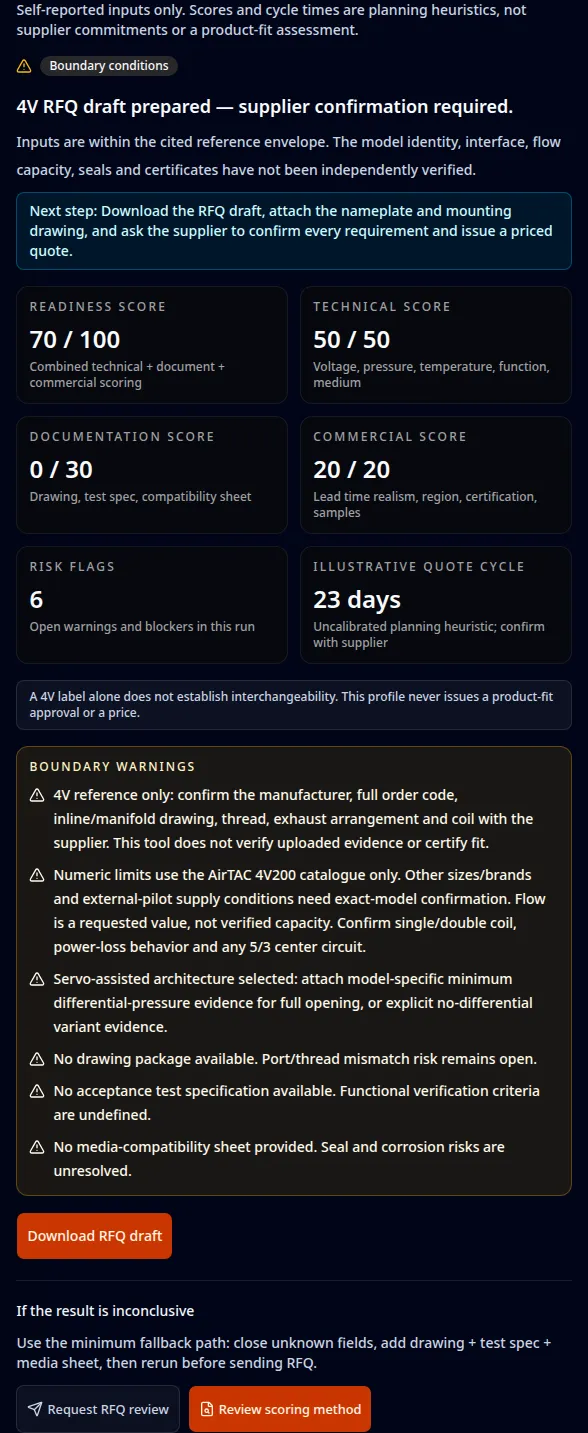
View an actual 4V checker result
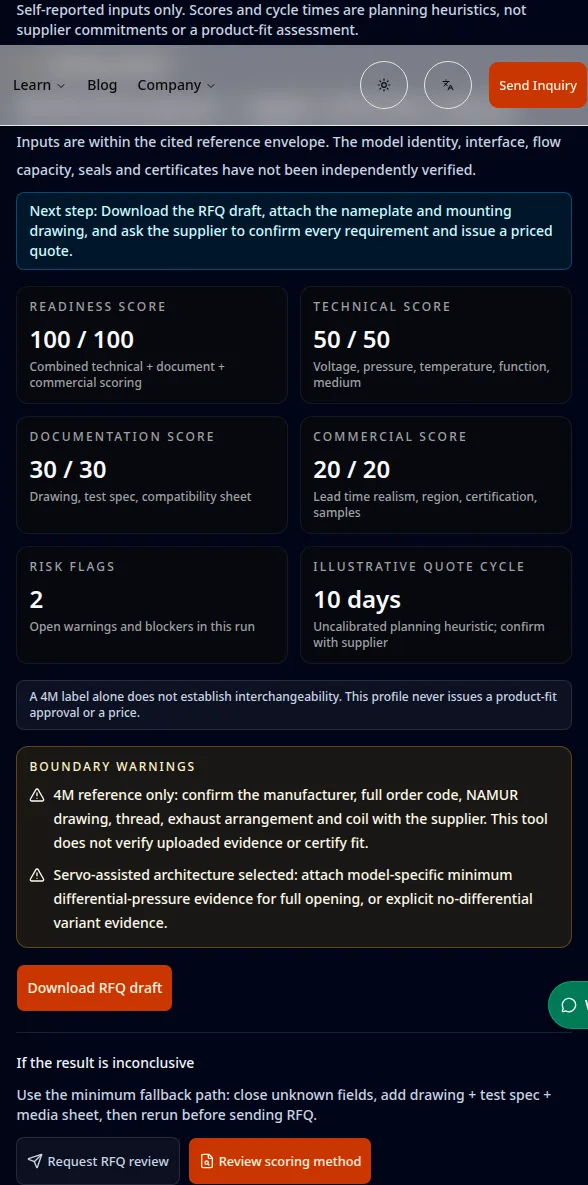
View an actual 4M checker result
- AirTAC 4V200 catalogue (2 pages)
Scope: 4V200 numeric reference only; other sizes require their own datasheets
Printed pages 88–89: 5/2 and 5/3 variants, operating limits, coil data, order codes and dimensions. Catalogue checked September 21, 2026.
- AirTAC 4M NAMUR catalogue (2 pages)
Scope: 4M100/200/300 reference only; no universal 4M interchangeability claim
Printed page 85: model scope, operating limits, coil data and order codes; page 86: mounting dimensions.
- AirTAC official 4M product page
Scope: 5/2 internal-pilot family
Manufacturer product identification and installation guidance.
Core conclusions and key numbers
The middle layer answers immediate decisions: what is true now, what is boundary-only, and what action follows.
Check the nameplate and actuator drawing before comparing suppliers. Different functions, threads and coils can share a similar product name.
Select the 4V/4M profile for its catalogue limits. General valve heuristics must not be treated as a 4V or 4M product rating.
Missing electrical, pneumatic pressure, flow, and commercial fields trigger controlled fallback instead of pretending a 2-way or 3-way valve quote is ready.
General pass requires both the score and evidence gates. The 4V/4M profile always stays pending supplier confirmation, regardless of score.
EU PED scope is defined by pressure class and conformity path, so voltage-only RFQ phrasing is insufficient for release decisions.
Bürkert Type 6213 notes a minimum differential pressure requirement for full opening, while Type 6013 is direct-acting.
| Question | Short answer | Why it matters |
|---|---|---|
| Can the same RFQ checklist cover 2-way, 3-way, 4V and 4M requests? | Yes, but select the correct profile and record the actual valve function. The 4V/4M profile uses separate limits and requires supplier confirmation. | Keeps supplier responses comparable without assuming the valves are interchangeable. |
| Is a "4V solenoid valve" a 4-Volt DC valve or a pneumatic type? | In industrial contexts, "4V" usually refers to a 5-port directional control pneumatic valve series (like AirTAC 4V210-08), not a 4-volt electrical coil. Always check the actual coil voltage label (e.g., 24V DC or 110V AC). | Separates the 4V series designation from the actual electrical rating; a custom low-voltage coil requires separate evidence. |
| Can I send a 2-way or 3-way pneumatic solenoid valve RFQ with only voltage, thread size, and product photo? | No. The checker forces numeric windows and documentation completeness first. | Reduces revision loops caused by hidden pressure, medium, and test assumptions. |
| Does “12V” or “24V” automatically remove EU compliance work? | No. Assess EMC, pressure and hazardous-area requirements for the actual equipment and use case. This checklist does not determine legal conformity. | Prevents false “low-voltage = no compliance” assumptions before quote release. |
| What readiness score should trigger supplier quote round? | For the general profile, pass also requires all document gates and known material, region and certification scope. The 4V/4M profile always requires supplier confirmation even when its score is high. | Creates an auditable gate before procurement dispatch and supplier comparison. |
| When should result stay in boundary state? | When key values are present but thermal, material, certification, or lead-time constraints remain weak. | Allows progress without masking risk as full approval. |
| Can pilot-assisted valves be treated like direct-acting valves at near-zero differential pressure? | No. Evidence must confirm the selected architecture; some servo-assisted variants explicitly require differential pressure for full opening. | Avoids low-pressure opening failures caused by architecture mismatch. |
| What is the minimum RFQ pack for this page flow? | Drawing, ISO-style circuit symbol/function, acceptance test criteria, compressed-air quality target, media compatibility statement, and destination/compliance scope. | Improves first-pass quote comparability and avoids hidden contamination or circuit-function assumptions. |
| Should compressed-air quality be included in a 2-way or 3-way pneumatic valve quote? | Yes when contamination, moisture, or oil carryover can affect seals, sticking, leakage, or warranty assumptions. | Turns vague “air valve” intent into a measurable purity requirement instead of a supplier guess. |
| Does pass output remove compliance and service obligations? | No. Compliance scope and maintenance safety are separate gates documented in the report layer. | Prevents pass-overconfidence during handoff to sourcing teams. |
| Why specify a 24V DC solenoid valve instead of 12V DC? | At equal power, 24V draws half the current of 12V. Check actual coil wattage, cable resistance and the output-module rating before choosing either voltage. | The actual coil-terminal voltage must remain within its manufacturer limits. |
| What is the role of the exhaust port in a 3-way pneumatic solenoid valve? | For a normally closed 3/2 valve, the normal state typically connects work port 2 to exhaust 3. A normally open version instead connects supply 1 to work port 2. Confirm both states from the exact circuit symbol, including silencer and exhaust backpressure requirements. | If not specified, the exhaust port may lack a silencer, causing safety hazards from noise, or missing backpressure limits that slow actuator reset time. |
| Scenario | Inputs visible before dispatch | Checker state | RFQ action |
|---|---|---|---|
| 3-way RFQ-ready sample | 24V DC coil, 21.6-27.6V supply window, 8 bar pressure, 18 L/min flow, 12 mm ports, 35C ambient, 55C media, 3/2 direct-acting air service, Port 1 supply / Port 2 work / Port 3 exhaust state table, brass body, North America destination, drawing/test/compatibility docs present. | Pass path when no hard blockers remain and the exhaust path is explicit; dispatch can move into supplier comparison with the same numeric and port-state assumptions. | Send one RFQ package request with voltage window, 3/2 function symbol, port-state table, exhaust silencer/backpressure assumptions, pressure/flow limits, material, destination, samples, annual demand, lead-time target, and acceptance test criteria. |
| Label-only 3-way / 24V inquiry | Keyword, product photo, or coil label says 3-way or 24V, but pressure, flow, port-state table, architecture, medium, material, destination, test criteria, and compatibility evidence are unknown. | Needs-data by design; the page does not treat the 3-way or 24V phrase as quote-ready evidence. | Collect the missing electrical, pneumatic, material, compliance, and commercial values before contacting suppliers. |
| Low differential-pressure pilot candidate | 24V pilot-assisted 2-way or 3-way pneumatic valve candidate, low or near-zero differential pressure, incomplete proof of minimum opening pressure, and no supplier curve attached. | Boundary state until architecture evidence confirms opening behavior at the requested operating point. | Request direct-acting or zero-differential proof, pressure-drop data, and supplier acceptance test language before quote release. |
| Signal | Number | Interpretation note |
|---|---|---|
| EU low-voltage page marker | LVD voltage scope: 50–1000 V AC and 75–1500 V DC | Shows that “12V” or “24V” phrasing alone does not finish compliance scoping. |
| EU pressure-equipment threshold | PED scope: stationary pressure equipment >0.5 bar; entered into force 20 Jul 2016 | Pressure class is a hard quote-scoping dimension beyond voltage label. |
| EU ATEX recency marker | ATEX 2014/34/EU guideline 6th edition issued Jan 2026 | Hazardous-area requests must be handled as dedicated evidence paths. |
| ISO 4414 status marker | Edition 3 (2010-11), reviewed and confirmed in 2021 | Supports system-level pneumatic safety framing for RFQ boundary controls. |
| ISO 8573 compressed-air quality marker | ISO 8573-1:2010 defines purity classes for particles, water, and oil; status is published and marked to be revised | RFQs should state air-quality assumptions when contamination can affect valve operation or acceptance. |
| ISO 1219 diagram marker | ISO 1219-1:2012 specifies fluid-power graphical symbols; Edition 3 is under review | A 2/2 NC or 2/2 NO request should include a circuit symbol or equivalent function drawing, not only a phrase. |
| ISO 228 thread boundary | ISO 228-1:2000 (confirmed 2022) says thread is not for pressure-tight joint on the thread | Thread designation alone cannot substitute for seal and leakage strategy evidence. |
| ISO flow-test uncertainty update | ISO 6358-1:2013/Amd 2:2026 published in 2026-04 | Flow claims need explicit test method and uncertainty disclosure in RFQs. |
| Actuation architecture boundary (Bürkert) | Type 6213 states minimum differential pressure needed for full opening; HP00 variant opens without differential pressure | Pilot-assisted selection cannot be approved on voltage tags only. |
| Checker pass threshold | General: readiness >=80, no hard blockers, document and known-field gates satisfied | RFQ completeness only. The 4V/4M profile never issues an unconditional pass. |
| Checker boundary threshold | General score 55-79, or unresolved evidence at a higher score | Allows controlled progress while forcing risk disclosure and mitigation. |
| Hard electrical screening envelope | Preferred -10%/+20%, hard stop outside -15%/+25% around requested voltage | General heuristic only, not a coil rating. The 4V/4M DC profile instead uses the cited ±10% limit. |
| Pressure boundary in tool layer | Boundary >16 bar, hard stop >25 bar (generic screen) | Higher-pressure selections need explicit supplier proof and valve-seat validation. |
| Review cadence | Published May 25, 2026; next review March 21, 2027 | Time-sensitive assumptions are scheduled for periodic re-check. |
| UL electrical-valve safety scope | UL 429 scope covers electrically operated general-purpose and safety valves rated 600 V or less | A 12V or 24V coil can still need product-level safety evidence when the buyer requires UL-recognized or UL-listed valve documentation. |
| Ingress-protection boundary | IEC 60529 classifies enclosure protection up to 72.5 kV equipment; NEMA Type 4X adds corrosion protection language | IP65/IP67/NEMA 4X claims must be tied to enclosure rating evidence, not inferred from “waterproof solenoid valve” wording. |
| US import classification boundary | USITC HTS Chapter 84 current release is the live starting point | Landed-cost quote packs should keep HTS classification and duty assumptions separate from technical valve fit. |
| 24V DC wiring efficiency limit | A 24V DC coil draws 50% less current than a 12V DC coil of the same wattage; a 1V cable drop is only a 4.2% loss at 24V vs 8.3% at 12V | Compare actual coil wattage and cable loop resistance, then verify terminal voltage against the selected coil rating; nominal voltage alone does not establish reliable pull-in. |
| IEC 61131-2 PLC output standard | IEC 61131-2:2017 covers industrial control equipment requirements and tests | 24V DC solenoid quotes for factory automation should specify whether a flyback diode (surge suppression) is included to protect the PLC. |
| 3/2 port identification and interface evidence | Name supply/work/exhaust ports, attach a port-state table, and cite ISO 11727 / ISO 15218 where relevant | Quotes for 3/2-way valves must distinguish the exhaust path and silencer or backpressure assumptions from the supply path. |
Evidence that changes the quote decision
Use the sources below to identify supporting documents and unresolved requirements.
| Signal | Reference fact | How it changes decisions |
|---|---|---|
| LVD public marker | EU LVD page states applicability since 20 April 2016 and references below-50 VAC / below-75 VDC consumer context. | Used to block “12V” or “24V” label-only approvals and force full compliance scoping. |
| PED trigger condition | PED 2014/68/EU page states scope above 0.5 bar for stationary pressure equipment; entered into force on 20 July 2016. | Used as a pressure-based release gate independent of nominal coil voltage. |
| ATEX update recency | ATEX equipment page lists Directive 2014/34/EU and a 6th-edition guideline issued in January 2026. | Hazardous-area requests remain boundary/fail until dedicated evidence is attached. |
| EMC scope statement | EMC directive page states apparatus and fixed installations must comply when placed on the market and/or taken into service. | Prevents treating low-voltage labels as automatic EMC exemption. |
| ISO 4414 lifecycle | ISO 4414:2010 (Edition 3) is published and marked reviewed/confirmed in 2021. | Supports safety and maintenance boundaries in method and risk sections. |
| ISO 8573 compressed-air quality | ISO 8573-1:2010 specifies compressed-air purity classes for particles, water, and oil independent of where the air is specified or measured. | Adds a quote field for air-quality assumptions when valve sticking, leakage, or seal life could be affected. |
| ISO 1219 circuit evidence | ISO 1219-1:2012 specifies rules for fluid-power graphical symbols used for components and circuit diagrams. | Requires a symbol or equivalent circuit function proof before treating “2-way” or “3-way” wording as unambiguous. |
| ISO 228 interface boundary | ISO 228-1:2000 page states threads are not suitable where pressure-tight joint is made on the thread; points to ISO 7-1 for pressure-tight thread joints. | Adds a concrete thread/sealing RFQ requirement before quote release. |
| ISO 6358 update | ISO 6358-1:2013/Amd 2:2026 shows publication date 2026-04 and focuses on measurement uncertainty evaluation. | Flow and Cv claims must include test method and uncertainty context. |
| Supplier architecture evidence | Bürkert Type 6213 description states minimum differential pressure needed for full opening; HP00 variant opens without differential pressure. Type 6013 is described as direct-acting. | Added to boundaries so pilot/direct-acting assumptions are not mixed without proof. |
| UL 429 safety-standard scope | UL 429 covers electrically operated general-purpose and safety valves rated 600 V or less and intended for fluid control. | Adds a North America safety-document gate when an RFQ asks for UL evidence, even if the coil is only 12V or 24V. |
| IEC/NEMA enclosure evidence | IEC 60529 classifies degrees of enclosure protection, while NEMA Type 4X language includes hose-directed water and additional corrosion protection. | Outdoor, washdown, IP67, or NEMA 4X RFQs now require explicit enclosure rating and installed-state assumptions. |
| USITC HTS import boundary | USITC current-release HTS Chapter 84 is the official public starting point for US tariff classification work on valve-related imports. | Separates technical quote readiness from duty, origin, and landed-cost assumptions before procurement compares suppliers. |
| IEC 61131-2 PLC standard | IEC 61131-2 covers industrial control equipment requirements. Check the selected output module and coil manuals for current, inductive-load rating and suppression. | Requires 24V DC RFQs in automation to explicitly specify if coil surge suppression is integrated or supplied externally. |
| Voltage drop physics (24V vs 12V) | For equal wattage, 24V DC draws half the current of 12V DC. Because voltage drop is proportional to current, 24V halves the drop and is half as sensitive to a 1V loss. | For the same power and cable resistance, the higher voltage reduces percentage drop. Actual coil wattage and pull-in requirements must still be checked. |
| 3/2-way port and exhaust evidence | ISO 11727 covers port and control-mechanism identification for pneumatic directional control valves, while ISO 15218 covers 3/2 solenoid-valve mounting-interface dimensions. | Forces explicit supply/work/exhaust naming, port-state table evidence, and minimum-pressure assumptions before a 3-way RFQ is treated as quote-ready. |
| Pneumatic 4V series designation boundary | The "4V" label on a pneumatic valve (e.g., AirTAC 4V100/200/300/400) denotes a 5/2 or 5/3 directional control series for inline or manifold mounting, distinctly separate from the "4M" NAMUR series used for direct actuator mounting. | Used to prevent conflating inline/manifold 4V series valves with direct-mount 4M NAMUR valves during RFQ preparation. |
| Topic | Status | Why still pending | Minimum next action |
|---|---|---|---|
| Cross-vendor quote-cycle benchmark by RFQ completeness | Pending / no reliable public dataset | Public sources do not provide normalized, apples-to-apples lead-time deltas across valve families and regions. | Keep internal lead-time estimates explicitly labeled as heuristics until supplier-specific historical data is available. |
| Universal numeric differential-pressure threshold for all pilot-assisted valves | Pending / no reliable public dataset | Thresholds vary by seat design, orifice, medium, and manufacturer-specific variants. | Use part-number data sheet values and keep boundary output when architecture evidence is incomplete. |
| Open normalized field-failure rate by body material + medium pairing | Pending / no reliable public dataset | Available public information is fragmented and not normalized for duty profile or media chemistry. | Require compatibility documentation and application-specific validation evidence before final award. |
| Universal compressed-air purity class for every 2-way or 3-way valve RFQ | Pending / no reliable public dataset | Required purity depends on seal material, duty cycle, downstream filtration, failure mode, and warranty conditions. | Specify the project air-quality target or ask suppliers to state required filtration and moisture/oil limits for the proposed part. |
| Universal IP-to-NEMA equivalence for every valve installation | Pending / no reliable public dataset | IP and NEMA ratings use different test and declaration frameworks, and installed-state cable entry, conduit, gasket, and corrosion assumptions can change the result. | Request the exact enclosure rating, test basis, installed cable-entry assumptions, and corrosion requirements instead of converting labels by shortcut. |
| Stable US landed-cost forecast from keyword alone | Pending / no reliable public dataset | HTS classification, country of origin, Section 301/IEEPA status, and product configuration can change duty assumptions. | Keep tariff assumptions out of the technical pass score and require procurement or broker confirmation before final award. |
| Universal backpressure vs exhaust time curves for 3-way valves | Pending / no reliable public dataset | Actuator reset time depends heavily on silencer clogging, hose volume, and the specific Cv/Kv value of the exhaust path, which can differ from the supply path. | Request full C-value/Kv data for the exhaust flow path separately from the supply path in critical high-speed applications. |
How the checker maps ambiguity into deterministic output
Tool layer decides status. Report layer explains why the status is trustworthy and where it is still limited.
The score is useful only when accompanied by blockers, warnings, and explicit next-step commands.
| Stage | What is checked | Pass rule | Boundary/fail rule |
|---|---|---|---|
| Input integrity gate | Numeric fields (voltage window, pneumatic working pressure, target flow, temperature, demand, lead time, sample qty), core categorical fields, and whether function/air-quality evidence exists. | All required numeric fields valid and in range; no impossible ordering. | Missing core fields -> needs-data; invalid ranges -> error/fail. |
| Technical score (0-50) | Voltage fit, pressure fit, thermal fit, valve function definition, medium definition, and actuation architecture fit. | Strong score with no hard boundary violations. | Out-of-window values reduce score; critical extremes trigger hard blockers. |
| Actuation architecture gate | Direct-acting vs servo-assisted intent and whether differential-pressure evidence is provided for pilot behavior. | Architecture is explicit and supported by part-level data sheet constraints. | Unknown architecture or missing differential-pressure evidence remains boundary/needs-data. |
| Documentation score (0-30) | Drawing pack, ISO-style function/circuit proof, acceptance test spec, media compatibility sheet, and air-quality assumptions. | All three artifacts attached for highest confidence. | Missing artifacts increase warning count and expected quote cycle days. |
| Commercial score (0-20) | Lead-time realism vs annual demand, destination region, certification clarity, sample plan. | Lead time and demand are coherent, certification and region are explicit. | Aggressive timeline or unknown destination/compliance lowers readiness. |
| Regulatory route gate | Destination/compliance route against EMC, PED, ATEX, and service-safety obligations. | Compliance owner and evidence route are explicit for the actual use case. | 12V/24V label-only logic or ambiguous hazardous/pressure scope stays boundary. |
| Final decision mapping | Aggregate score + hard blockers + warning density. | Pass >=80, no hard blockers, low warning density. | 55-79 -> boundary; <55 or unresolved core definitions -> needs-data; hard blockers -> fail. |
Use / not-use boundaries
This keeps the page from being over-extended into problems it does not solve.
| Dimension | Suitable when | Not suitable when | Action |
|---|---|---|---|
| RFQ scope | Team needs one shared set of operating and documentation requirements for comparing solenoid valve quotes. | Team needs an instant price or a certified replacement decision from a model prefix alone. | Record the full order code and operating conditions, then request a dated supplier quote. |
| Electrical screening scope | 12V/24V-centric RFQ precheck with supply window evidence and fallback states. | Final EMC/compliance/product-certification approval workflow. | Use checker for pre-RFQ; do formal validation in project compliance flow. |
| Actuation architecture evidence | Architecture is declared (direct-acting or servo-assisted) and differential-pressure behavior is backed by part-level data sheet evidence. | Pilot/direct assumptions are guessed from voltage label or copied from unrelated models. | Attach model-specific architecture statement and opening-condition proof in RFQ. |
| Pressure and medium definition | Initial pressure/flow/medium declaration before supplier shortlist, including compressed-air quality when it can affect seal or leakage performance. | Exact valve-seat lifetime validation or process certification sign-off. | Request part-number test data before production decisions. |
| Valve function diagram | 2/2 NC, 2/2 NO, or other function is shown with a circuit symbol, drawing, or unambiguous port-state table. | “2 way pneumatic” wording is used without confirming normal state, port labels, exhaust behavior, and energized/de-energized flow path. | Attach ISO 1219-style symbol or a simple port-state table to the RFQ package. |
| Thread and sealing responsibility | Thread standard is paired with sealing strategy and leak-test expectation. | Thread code is used as implied proof of pressure-tight sealing without joint strategy. | State thread form + sealing method + leak-test target in the RFQ package. |
| Documentation readiness | Teams that can provide drawing + test spec + compatibility statement. | Photo-only or keyword-only sourcing requests. | Use needs-data path and complete minimum pack before release. |
| Commercial planning | Need lead-time and sample strategy before sending quote round. | Teams expecting instant fixed quote without clarified requirements. | Set realistic timeline and sample objectives before comparison. |
| Risk governance | Workflow that treats warnings as actionable closure tasks. | Workflow that ignores boundary warnings after seeing a score. | Close warnings with evidence and rerun before final shortlist. |
| Ingress-protection and enclosure claims | Outdoor, washdown, IP, or NEMA requirements are stated with rating evidence and installed-state assumptions. | “Waterproof” or “outdoor” is used as a keyword without enclosure test basis, cable entry assumptions, or corrosion requirement. | Ask for exact IP/NEMA rating evidence and installation conditions before comparing quotes. |
| US safety and landed-cost scoping | North America RFQ asks separately for UL 429-style valve evidence and HTS/duty assumptions. | Buyer expects the technical checker score to settle UL listing, tariff classification, origin, and duty exposure. | Keep safety certification and landed-cost review as named procurement gates outside the readiness score. |
| Public-data certainty | Team accepts explicit pending labels where no reliable public dataset exists. | Workflow requires precise universal numbers even when no trustworthy open dataset exists. | Keep uncertain claims tagged as pending and use supplier-specific evidence for release. |
| PLC output compatibility | Coil current, output-module inductive-load rating and suppression are checked against both manufacturers’ manuals. | A matching 24V label is treated as proof of electrical compatibility. | Specify surge suppression requirement in the 24V DC RFQ. |
| Cable run length (12V vs 24V) | Coil terminal voltage is checked at pull-in and holding current for the actual wire length and resistance. | Cable length or nominal voltage alone is used to approve the circuit. | Calculate I × loop resistance and compare the remaining terminal voltage with the exact coil limits. |
Workflow alternatives and tradeoffs
This table helps teams choose an intake pattern based on speed, confidence, and rework risk.
| Option | Speed | Confidence | Risk | Best for |
|---|---|---|---|---|
| This RFQ checklist and evidence guide | Fast first-pass gate with explicit fallback states | Input completeness only; supplier verification still required | Unverified part data remains an open risk | Teams needing immediate action and decision rationale in one place |
| Email-only freeform RFQ intake | Fast to start, slow to stabilize | Low to medium (depends on sender completeness) | High clarification-loop and mismatched assumption risk | Very early conversations without structured requirements |
| Spreadsheet checklist without decision logic | Moderate | Medium (data captured, but no deterministic status mapping) | Boundary interpretation varies by reviewer | Teams that already have strong internal review discipline |
| Catalogue-only part selection | Fast for known replacement codes | Depends on exact part identity and catalogue revision | A similar code may hide different threads, coils or seals | Confirmed like-for-like replacements with current drawings |
| Supplier portal request form only | Fast entry, variable output quality | Medium if supplier form fields are rigorous | Cross-supplier comparability can be weak | Single-supplier continuation after internal precheck |
| Standards-tagged RFQ packet (PED/ATEX/EMC + method references) | Moderate setup, faster downstream clarification | High when scope boundaries are explicit | Lower compliance-ambiguity and re-quote risk | Teams with multi-region or hazardous/pressure-sensitive deployments |
| Circuit-symbol + air-quality RFQ packet | Moderate setup, faster technical clarification | High when function and compressed-air assumptions are explicit | Lower mismatch risk for 2/2 normal state, seal life, and acceptance testing | 2-way or 3-way pneumatic projects where contamination or circuit ambiguity can derail supplier comparison |
| Compliance-tagged RFQ packet (UL/IP/NEMA/HTS fields separated) | Slower intake, faster procurement/legal review | High when evidence owners and assumptions are named | Lower risk of mixing technical fit with safety listing, enclosure, and tariff assumptions | North America, outdoor, washdown, or import-sensitive purchases where quote price alone can mislead |
Scenario playbooks: premise -> process -> outcome
Hypothetical preparation examples, not measured customer outcomes. Supplier response times and installed performance require separate evidence.
| Scenario | Starting assumption | Checker process | Expected outcome | Boundary control |
|---|---|---|---|---|
| Pilot quote batch with complete RFQ pack | 12V or 24V on/off valve project with pressure, flow, temperature, and full document pack ready. | Run RFQ-ready preset -> verify pass (>=80) -> export score and warnings snapshot. | A shared requirements draft for supplier review; response time depends on the supplier. | Still request part-number-level confirmation for certification and lifetime data. |
| Alias-only inquiry from sales lead | Input arrives as "12v solenoid valve quotes" or "24v solenoid valve quotes" keyword plus photo, without numeric limits. | Run label-only preset -> observe needs-data state -> close missing numeric/document fields before rerun. | Avoids false quote release and moves team into controlled evidence collection. | Use minimum pack gate: drawing + test criteria + media compatibility statement. |
| High-pressure request under tight delivery promise | Pressure near/above boundary with aggressive lead-time expectation and uncertain sample plan. | Run custom inputs -> capture boundary/fail warnings -> adjust pressure proof and timeline assumptions. | Procurement gets realistic quote cycle expectations instead of unstable delivery commitments. | Treat >16 bar as boundary evidence path and block >25 bar until part-level proof exists. |
| Low differential-pressure process with pilot-assisted candidate | Buyer prefers pilot-assisted valve but process differential pressure may be low or unstable. | Run custom inputs -> keep boundary state unless architecture and opening-condition evidence is attached. | Stops architecture mismatch before supplier round and avoids low-pressure opening failures. | Escalate to part-level data sheet evidence or switch to direct-acting candidate when needed. |
| Plant air quality unknown | Compressed-air source is known only as “shop air”; filtration, moisture, and oil carryover are not documented. | Run custom inputs -> keep boundary status if medium compatibility is weak -> add air-quality target or supplier-required filtration note. | Supplier quotes include realistic seal, filtration, and acceptance-test assumptions instead of generic air-valve pricing. | Use ISO 8573-1 as the vocabulary for purity class discussion, but do not invent a class without project evidence. |
| 2-way or 3-way function described without diagram | RFQ says “2 way pneumatic solenoid valve” but does not state normally closed/open state or port behavior. | Run label-only or custom inputs -> keep needs-data/boundary -> attach symbol, port-state table, or circuit sketch. | Supplier intake can compare the same function instead of quoting incompatible 2/2 variants. | Use ISO 1219-style symbol language or equivalent drawing proof before supplier dispatch. |
| Global destination with compliance ambiguity | Destination region and certification scope are unclear at pre-RFQ stage. | Run inputs with unknown compliance fields -> review warning stack -> define destination and cert targets. | Reduces redesign and document-delay risk before supplier shortlist is locked. | Keep boundary status until compliance owner confirms region-specific requirements. |
| Outdoor washdown machine with “waterproof” wording | Buyer asks for waterproof 12V or 24V 2-way or 3-way valve but does not state IP/NEMA rating, cable entry, or corrosion exposure. | Run technical inputs -> keep boundary action open -> request IP/NEMA evidence and installed-state assumptions. | Supplier quotes become comparable on enclosure rating and corrosion expectation instead of marketing wording. | Do not convert IP and NEMA labels by shortcut; require exact rating evidence and installation assumptions. |
| US import purchase where unit price looks attractive | Supplier quote excludes duty, origin, and classification assumptions for valve or valve-part imports. | Run quote-readiness checker for technical fit -> add procurement gate for HTS/origin/duty review before award. | Technical pass does not hide landed-cost uncertainty or later compliance rework. | Use USITC HTS current release as starting evidence, then obtain broker/procurement confirmation. |
| Long cable run in factory automation | Valve is 50 meters away from the power supply; buyer is unsure between 12V and 24V. | Calculate cable drop separately -> enter the actual coil-terminal supply window -> compare the exact coil rating. | Makes the voltage-drop assumption explicit; the checker itself does not model wire resistance or pull-in current. | Choose voltage and conductor size using the actual coil and cable data; validate pull-in at the lowest supply. |
Risk matrix with mitigation actions
Risk statements are concrete and tied to operational triggers.
1. Use one revision of the RFQ template for every supplier.
2. Attach minimum technical document pack before dispatch.
3. Flag compliance scope and destination before quote compare.
4. Convert boundary warnings into closure tasks with owners.
5. Re-run checker after every major scope change.
| Risk | Trigger | Impact | Mitigation |
|---|---|---|---|
| Conflicting RFQ versions | Sending different pressure, coil or interface requirements to different suppliers. | Prices cannot be compared on the same technical basis. | Version the RFQ draft and distribute the same revision to all suppliers. |
| Voltage-label overconfidence risk | Approving quote from “12V” or “24V” label without measured supply window. | Incorrect coil behavior assumptions and quote rework. | Capture min/max supply evidence and enforce score gates. |
| Pressure under-specification risk | Quote request omits real operating pressure profile. | Incompatible valve-seat or leakage performance in field. | Treat >16 bar as boundary and request part-level proof. |
| Material-medium mismatch risk | Unknown medium or no compatibility sheet in RFQ package. | Seal degradation/corrosion and shortened service life. | Require media compatibility statement before final supplier selection. |
| Compressed-air contamination risk | RFQ says “air” but omits particle, moisture, and oil expectations or filtration responsibilities. | Valve sticking, seal wear, leakage disputes, or warranty ambiguity after installation. | State compressed-air quality target or request supplier-required filtration/moisture/oil limits. |
| 2-way/3-way function ambiguity risk | RFQ omits normal state, energized/de-energized flow path, port labeling, or circuit symbol. | Supplier quotes different 2/2 variants and comparison becomes invalid. | Attach ISO 1219-style symbol, port-state table, or circuit drawing with the RFQ. |
| Certification ambiguity risk | Destination/compliance scope not defined before quote round. | Unexpected redesign or documentation delay. | Declare destination region and certification need up front. |
| Regulation-scope shortcut risk | Assuming “12V” or “24V” phrasing automatically removes EMC, pressure, or hazardous-area obligations. | Late compliance redesign and quote restart. | Map EMC/PED/ATEX obligations in RFQ scope before supplier comparison. |
| Actuation mismatch risk | Pilot-assisted selection without differential-pressure evidence for real operating conditions. | Opening failures, unstable behavior, or unplanned model change. | Require architecture-specific opening evidence and keep boundary status when missing. |
| Thread sealing assumption risk | Treating thread callout alone as proof of pressure-tight sealing strategy. | Leak risk, rework, and delayed acceptance testing. | Pair thread specification with sealing method and leak-test criteria in RFQ. |
| Documentation gap risk | No drawing and no acceptance criteria attached. | Multiple quote-revision loops and low comparability. | Attach minimum RFQ pack before release. |
| Service safety blind spot | Assuming quote readiness equals field safety readiness. | Stored-energy and maintenance procedure risks remain unmanaged. | Keep maintenance safety in project-level sign-off checklist. |
| Ingress-protection overclaim risk | Quote request says waterproof, outdoor, IP67, or NEMA 4X without attached rating evidence and installation assumptions. | Field leakage, corrosion exposure, warranty dispute, or false confidence in washdown environments. | Require exact IEC/IP or NEMA rating evidence, cable-entry assumptions, and corrosion requirement before award. |
| Safety-standard shortcut risk | Buyer assumes a low-voltage coil eliminates UL-style valve safety documentation needs. | Late document gap for North America purchasing, machine-builder approval, or customer PPAP-style file. | Separate UL 429 or customer-required safety evidence from the technical readiness score. |
| Landed-cost surprise risk | Imported quote compares unit prices without HTS classification, origin, duty, or trade-measure assumptions. | Award decision can reverse after broker review or tariff update. | Use USITC HTS as the starting point and require procurement/broker confirmation before final award. |
| Aggressive lead-time promise risk | High annual volume with unrealistic target lead time. | Unstable delivery promises and procurement friction. | Use checker lead-time realism score and adjust expectation before RFQ. |
| False precision risk for public benchmarks | Using unverified universal numbers for cycle-time or failure-rate forecasts. | Overconfident planning and weak corrective actions when reality diverges. | Keep unknowns explicitly labeled and replace with supplier-specific evidence before release. |
| PLC output destruction risk (Transient spikes) | Switching an inductive coil without verifying output rating and an appropriate suppression path. | The turn-off transient can exceed the output rating; an unsuitable clamp can also delay valve release. | Ask the output and valve manufacturers to specify compatible suppression, polarity and release-time limits. |
| Voltage drop pull-in failure | Using 12V DC over long thin wires instead of 24V DC. | Terminal voltage may fall below the specific coil’s pull-in requirement; the symptoms and tolerance depend on its design. | Use actual coil power and loop resistance to compare alternatives; check the complete terminal-voltage window. |
Evidence ledger and explicit uncertainty
Core claims are tied to either internal planning artifacts or public references. Unknowns remain labeled as unknowns.
| Topic | Known evidence | Unknown / pending | Next action |
|---|---|---|---|
| 4M product identity | The linked AirTAC catalogue identifies a 5/2 internal-pilot family. | Exact offered model and mounting fit | Obtain the full order code and supplier drawing. |
| Regulatory scoping for 12V/24V requests | EU LVD/EMC/PED/ATEX pages now define concrete scope triggers used in this page. | Product certification route still varies by market, installation, and use-case. | Keep compliance owner sign-off as a separate release gate after quote readiness. |
| Actuation architecture behavior | Type 6213 describes minimum differential pressure for full opening while HP00 variant can open without differential pressure; Type 6013 is direct-acting. | Universal numeric pilot threshold across all brands is not publicly normalized. | Use part-number datasheets and keep boundary status when opening-condition proof is missing. |
| Thread interface vs sealing responsibility | ISO 228-1 states those threads are not for pressure-tight joints made on the thread itself. | No single universal sealing method covers every medium/pressure duty profile. | Specify thread form, sealing method, and leak-test criteria in the RFQ package. |
| Cross-vendor performance benchmarking | ISO 6358 amendment recency is now explicit for flow-test uncertainty context. | No reliable public normalized dataset for universal quote-cycle or lifecycle ranking across all 12V/24V valve families. | Keep these claims in pending status and require supplier-specific historical evidence before award. |
- EU Low Voltage Directive scope page (European Commission)
Scope: Regulatory context for low-voltage discussions
Gives the LVD voltage scope: 50–1000 V AC and 75–1500 V DC. Other requirements must be assessed separately.
- EU Pressure Equipment Directive page (PED 2014/68/EU)
Scope: Pressure-classification boundary for quote scoping
Defines PED scope for stationary pressure equipment above 0.5 bar; entered into force on 20 July 2016.
- EU ATEX equipment page (Directive 2014/34/EU)
Scope: Hazardous-area applicability boundary
Covers explosive-atmosphere equipment and lists the 6th ATEX guideline edition issued in January 2026.
- EU EMC Directive page (2014/30/EU)
Scope: Electromagnetic compatibility scope gate
States apparatus and fixed installations must comply when placed on the market and/or taken into service.
- ISO 4414:2010 lifecycle page
Scope: Pneumatic system safety baseline and maintenance boundary
Edition 3 (2010-11), status published, last reviewed and confirmed in 2021.
- ISO 8573-1:2010 lifecycle page
Scope: Compressed-air quality and contamination boundary
Edition 3 (2010-04), status published and marked to be revised; defines compressed-air purity classes for particles, water, and oil.
- ISO 1219-1:2012 lifecycle page
Scope: Valve function and pneumatic circuit diagram evidence
Edition 3 (2012-06), under review; specifies graphical symbols for fluid power components and circuit diagrams.
- ISO 228-1:2000 lifecycle page
Scope: Thread/interface boundary in RFQ specs
Edition 4 (2000-09), confirmed in 2022; explicitly says threads are not for pressure-tight joints made on the thread.
- ISO 6358-1:2013/Amd 2:2026 lifecycle page
Scope: Flow-test method and uncertainty disclosure boundary
Amendment 2 published in 2026-04 for flow-characterization uncertainty evaluation.
- Bürkert Type 6013 data sheet (direct-acting 2/2 plunger valve)
Scope: Actuation-architecture comparison baseline
Product description states Type 6013 is a direct-acting plunger valve.
- Bürkert Type 6213 data sheet (servo-assisted 2/2 diaphragm valve)
Scope: Differential-pressure applicability boundary
Description states minimum differential pressure is required for full opening; HP00 variant can open without differential pressure.
- OSHA 29 CFR 1910.147 lockout/tagout
Scope: Maintenance and stored-energy risk framing
Requires control of hazardous energy and requires stored or residual energy to be relieved/disconnected/restrained before servicing.
- OSHA 29 CFR 1910.147 Appendix A
Scope: Residual pressure release and service handoff evidence
Typical minimum procedures call out air, gas, steam, or water pressure as stored energy that must be dissipated or restrained.
- UL 429 Electrically Operated Valves
Scope: North America electrical-valve safety standard boundary
Scope covers electrically operated general-purpose and safety valves rated 600 V or less for fluid control.
- IEC 60529 consolidated IP Code catalogue
Scope: Ingress-protection claim boundary for outdoor/washdown RFQs
IEC 60529 covers degrees of enclosure protection (IP Code) for electrical equipment rated up to 72.5 kV. Confirm the installed valve assembly and connector rating.
- NEMA Enclosure Types guide
Scope: NEMA/IP enclosure claim comparison boundary
NEMA Type 4X includes hose-directed water protection and an added corrosion-protection level for indoor or outdoor use.
- USITC Harmonized Tariff Schedule Chapter 84 current release
Scope: Import duty and landed-cost quote boundary
USITC current-release Chapter 84 HTS material is the public classification starting point for imported valve and valve-part quote assumptions.
- IEC 61131-2:2017 Programmable controllers - Equipment requirements
Scope: 24V DC PLC compatibility and inductive load protection
Defines functional and electromagnetic compatibility requirements and verification tests for industrial control equipment. It does not approve a particular PLC output for a valve coil.
- ISO 15407-1:2000 Pneumatic fluid power
Scope: Directional-valve mounting-interface boundary
Specifies dimensions and tolerances for 18 mm and 26 mm five-port directional-control-valve mounting interfaces.
- ISO 5599-1:2001 Pneumatic fluid power
Scope: Five-port directional-valve interface boundary
Specifies mounting-surface characteristics for five-port directional control valves without electrical connectors.
- ISO 11727:1999 Pneumatic fluid power port identification
Scope: Port identification evidence for 3/2 quote packages
Specifies rules for identifying and marking ports and control mechanisms on pneumatic directional control valves.
- ISO 15218:2003 Pneumatic 3/2 solenoid valve interface
Scope: 3/2 solenoid-valve mounting-interface evidence
Specifies dimensions and tolerances for mounting-interface surfaces used by 3/2 solenoid valves for four valve sizes.
- Bürkert Type 6014 circuit functions (3/2 normally closed/open)
Scope: 3/2 exhaust behavior depends on NC/NO circuit function
Function C vents the work port in its normal state; function D connects supply to the work port instead. Confirm both switching states from the exact model symbol.
- AirTAC 4V Series (4V100/200/300/400) product data
Scope: Pneumatic 4V series designation boundary
Defines 5/2 and 5/3 directional control valves for inline/manifold mounting. 4V is a pneumatic valve series, not a 4-Volt electrical rating.
Solenoid valve quote decision FAQ
Questions about requirements, scoring, and supplier handoff.
What distinguishes a 2-way request from a 3-way request?
Record the required port connections in each energized and de-energized state. A function label alone does not establish fail state or installation compatibility.
Does the checker explicitly cover 2-way and 3-way solenoid valve quotes?
Yes. The default function is 3/2 directional, a 2/2 normally closed preset remains available, and the tool asks for pressure, flow, port, architecture, material, documentation, and commercial inputs before quote release.
Does a 24V coil label identify the correct replacement?
No. Also confirm AC or DC, supply tolerance, electrical connection, valve function, pressure, medium and mounting. Use the 4M profile only within its stated reference scope.
Does this tool cover 4v and 4m solenoid valve quotes?
Yes. Select the 4V inline/manifold DC profile or the 4M NAMUR DC profile and enter the manufacturer, full order code and mounting/thread details. Numeric limits use the cited AirTAC 4V200 and 4M100/200/300 catalogues. Other 4V sizes need their own datasheets. Within-range results remain pending supplier confirmation; other manufacturers, AC coils and 3/2 conversions require separate evidence. Download the draft to request an actual priced quote.
How do I share this page internally without confusion?
Share /learn/solenoid-valve-quote-request#tool and the downloaded RFQ draft so colleagues can inspect the same inputs and unresolved items.
What if my valve is outside the reference scope?
Request the exact manufacturer datasheet and an application review. Do not change inputs merely to obtain a better score; send the real conditions with your drawing.
What does a pass score mean?
Pass means the RFQ package is quote-ready for supplier round. It is not a final compliance or lifetime guarantee.
What should I do with boundary output?
Use boundary output to close specific evidence gaps first, then rerun the checker to reduce quote revision risk.
What triggers needs-data state?
Missing core numeric values or unresolved critical definitions (for example unknown medium/function) trigger needs-data.
Why does a 2-way or 3-way pneumatic RFQ need a symbol or port-state table?
Because “2 way” does not fully define normally closed/open state, port labels, or energized/de-energized flow path. A symbol or port-state table makes supplier comparisons reproducible.
What are hard blockers?
Hard blockers are out-of-envelope conditions (such as extreme voltage or pressure boundaries) that must be corrected before RFQ release.
Why can a boundary state remain even when the score looks high?
Because architecture evidence, compliance scope, or sealing responsibility can still be unresolved even if raw numeric inputs look complete.
Which files should be attached with the RFQ email?
Attach drawing pack, circuit symbol or port-state table, acceptance test criteria, media compatibility statement, compressed-air quality target if relevant, and the checker result snapshot.
Do I need an ISO 8573 air-quality class in every quote?
Not always. Use it when contamination, moisture, or oil carryover can influence seal selection, leakage acceptance, sticking risk, warranty terms, or filtration responsibility.
Why does this page discuss maintenance safety?
Because quote readiness can still fail at deployment if stored-energy and maintenance procedures are ignored.
How often should this page logic be reviewed?
Review cadence is every six months. Last reviewed September 21, 2026; next review March 21, 2027.
What if public evidence is insufficient for a claim?
Do not force certainty. Mark unknowns explicitly, request supplier proof, and keep boundary status until evidence closes.
Does “waterproof solenoid valve” prove IP67 or NEMA 4X suitability?
No. Waterproof wording is not enough. Ask for the exact IEC/IP or NEMA rating, test basis, cable-entry assumptions, installed-state limits, and corrosion expectation before comparing quotes.
Does a 12V or 24V 2-way or 3-way valve still need UL-style evidence in North America?
It can. UL 429 covers electrically operated valves rated 600 V or less for fluid control, so buyer-required UL evidence should be handled as a separate document gate rather than hidden inside the checker score.
Should tariff and duty assumptions be part of the pass score?
No. Technical pass only means the RFQ facts are coherent for supplier round. US HTS classification, origin, duty exposure, and landed-cost assumptions need a procurement or broker review before award.
Can we use one universal lead-time or failure-rate benchmark across all 12V or 24V valve suppliers?
Not reliably from public data. Keep those assumptions marked as pending and replace them with supplier-specific historical evidence before final award.
Adjacent pages for deeper technical branches
Use these when your quote request evolves into a different actuator family decision.
Send a complete RFQ with the same requirements for every supplier
Export the checker result, attach your document pack, and send the RFQ on the same assumptions. If any boundary warning stays open, keep the request in controlled review rather than forcing a false pass.
Run tool layer and capture score + warnings.
Close boundary gaps using method and evidence sections.
Keep risk mitigations and compliance scope in final RFQ package.